
Come EqForecast costruisce WHEN, WHERE e HOW STRONG.How EqForecast builds WHEN, WHERE and HOW STRONG.
Questa pagina espone l’architettura scientifica generale del modello e il modo in cui i diversi livelli vengono combinati. È una descrizione pubblica: non contiene codice sorgente, soglie operative proprietarie né regole interne sufficienti a ricostruire gli algoritmi.This page describes the general scientific architecture of the model and how the different layers are combined. It is a public description: it does not contain source code, proprietary operational thresholds or internal rules sufficient to reconstruct the algorithms.
AstronomiaAstronomy
Geometrie, periodicità lunari e indicatori gravitazionali.Geometries, lunar periodicities and gravitational indicators.
Timeline · ATR
Prior temporale e classe teorica di magnitudo.Time prior and theoretical magnitude class.
OsservazioniObservations
Microsismicità INGV e risposta territoriale reale.INGV microseismicity and real territorial response.
ARR · WHERE · MAG
Restringimento combinato di tempo, spazio e magnitudo.Combined narrowing of time, space and magnitude.
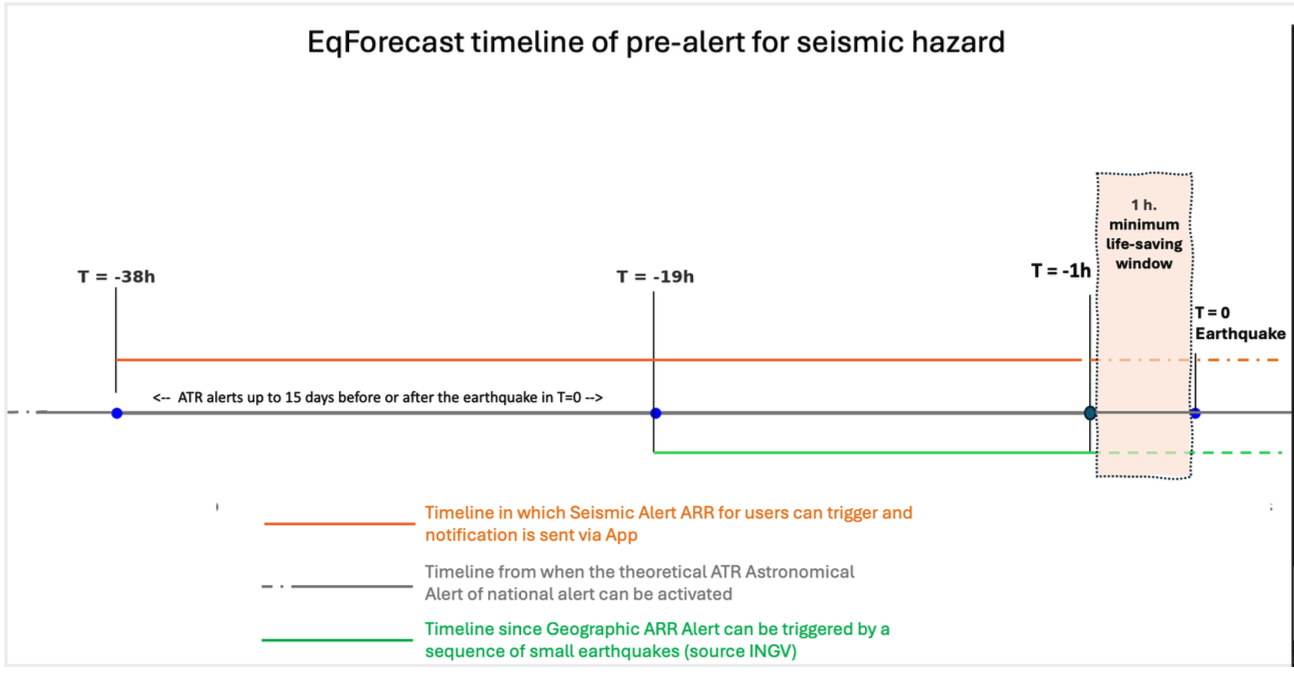
Come si restringe il tempo: dalla previsione teorica alla “life-saving window”.How time is narrowed: from theoretical forecasting to the life-saving window.
Per capire EqForecast è utile distinguere due livelli: prima la suscettibilità teorica, poi la verifica osservativa nel breve periodo.Understanding EqForecast requires separating two layers: theoretical susceptibility first, then short-term observational confirmation.
Allerta Teorica del Rischio astronomicoTheoretical Astronomical Risk Alert
È il contesto di suscettibilità teorica costruito dalla Timeline a partire dalla convergenza di configurazioni astronomiche, periodicità lunari e indicatori statistico-gravitazionali. L’ATR individua finestre in cui, secondo il modello, il sistema è più compatibile con un possibile innesco: non significa che un terremoto debba necessariamente verificarsi.It is the theoretical susceptibility context built by the Timeline from the convergence of astronomical configurations, lunar periodicities and statistical-gravitational indicators. ATR identifies windows in which the model finds conditions more compatible with a possible trigger; it does not mean an earthquake must occur.
Allerta del Rischio Reale astronomicoAstronomical Real-Risk Alert
È il livello che entra nel breve periodo quando la microsismicità realmente osservata mostra sequenze compatibili con la finestra ATR. L’ARR aggiorna il rischio teorico con evidenza strumentale e prepara il successivo restringimento geografico. È un aggiornamento probabilistico, non una certificazione dell’evento.It is the short-term layer activated when actually observed microseismicity shows sequences compatible with the ATR window. ARR updates theoretical risk with instrumental evidence and prepares the subsequent geographic narrowing. It is a probabilistic update, not a certification that an event will occur.
ARR
Può iniziare la fase di allerta reale su scala nazionale quando compaiono precursori microsismici compatibili.The real-risk alert phase may begin nationally when compatible microseismic precursors appear.
WHERE
L’algoritmo geografico entra nel breve periodo e restringe l’attenzione a un numero limitato di aree compatibili.The geographic algorithm enters the short-term phase and narrows attention to a limited number of compatible areas.
Finestra salvavita minimaMinimum life-saving window
Nel protocollo operativo descritto, la notifica localizzata mira a lasciare almeno 1 ora di margine prima dell’evento atteso nei casi compatibili con la procedura.In the described operational protocol, the localized notification is designed to leave at least 1 hour before the expected event in cases compatible with the procedure.
EventoEvent
Terremoto atteso secondo la sequenza considerata.Expected earthquake in the considered sequence.
Minimum life-saving windowMinimum life-saving window
È il margine minimo operativo che EqForecast mira a preservare tra l’ultima allerta localizzata utile e l’evento atteso. Non significa che ogni terremoto sarà previsto con un’ora di anticipo: la procedura si applica solo quando ATR, ARR e localizzazione geografica convergono e resta soggetta a falsi positivi e falsi negativi.This is the minimum operational margin EqForecast aims to preserve between the last useful localized alert and the expected event. It does not mean every earthquake will be forecast one hour in advance: the procedure applies only when ATR, ARR and geographic localization converge and remains subject to false positives and false negatives.
EqForecast e sistemi Early Warning a onde P: complementari, non alternativi.EqForecast and P-wave Early Warning: complementary, not competing.
I due sistemi lavorano in momenti diversi della stessa catena di protezione.The two systems work at different moments of the same protection chain.
EqForecast
Stima probabilistica pre-evento di WHEN, WHERE e HOW STRONG, con progressivo restringimento della finestra.Pre-event probabilistic assessment of WHEN, WHERE and HOW STRONG, with progressive narrowing of the window.
ARR + WHERE
La microsismicità reale e l’algoritmo geografico concentrano l’allerta sulle aree compatibili nel breve periodo.Real microseismicity and the geographic algorithm focus the alert on compatible areas in the short term.
Early Warning · onde P
Reti accelerometriche e sistemi P-wave rilevano il terremoto quando è già iniziato e possono fornire secondi preziosi prima dell’arrivo delle onde più distruttive.Accelerometric and P-wave systems detect the earthquake after rupture has already begun and can provide valuable seconds before the more damaging waves arrive.
Dal contesto astronomico alla finestra temporale operativa.From astronomical context to an operational time window.
Il WHEN è costruito come una catena di filtri temporali. Il primo livello è l’ATR: una suscettibilità teorica derivata dalla convergenza di più famiglie di segnali, tra cui periodicità lunari, geometrie angolari viste dalla Terra e indicatori di stabilità o instabilità del campo gravitazionale. Un punto concettuale importante della ricerca EqForecast è che non viene considerato soltanto il valore istantaneo di una grandezza: conta anche il suo ordine nel tempo, cioè la persistenza, la stabilità o il passaggio fra stati diversi.WHEN is built as a chain of temporal filters. The first level is ATR: a theoretical susceptibility derived from the convergence of several signal families, including lunar periodicities, angular geometries viewed from Earth and indicators of stability or instability in the gravitational field. A key conceptual point in EqForecast research is that the instantaneous value of a quantity is not considered alone: its temporal order also matters, including persistence, stability and transitions between different states.
La Timeline traduce questo contesto in finestre consultabili con dettaglio temporale fine. Quando il sistema entra nel breve periodo, l’ARR aggiunge informazione osservativa: la microsismicità reale viene usata come evidenza condizionante per verificare se il territorio stia mostrando una risposta compatibile con la finestra teorica. Il passaggio ATR → ARR va quindi inteso come aggiornamento probabilistico, non come interruttore deterministico.The Timeline translates this context into windows with fine temporal resolution. In the short term, ARR adds observational information: real microseismicity is used as conditioning evidence to assess whether the territory is showing a response compatible with the theoretical window. The ATR → ARR transition should therefore be understood as a probabilistic update, not a deterministic switch.
Cosa entra nel WHENWhat enters WHEN
- periodicità e geometrie lunari;lunar periodicities and geometries;
- configurazioni angolari e loro persistenza;angular configurations and their persistence;
- stabilità/instabilità di indicatori gravitazionali;stability/instability of gravitational indicators;
- convergenza di più filtri nella Timeline;convergence of multiple filters in the Timeline;
- microsismicità osservata nel breve periodo.observed short-term microseismicity.
Vedi anche il grafico della Timeline ARR →See the ARR Timeline chart →
Dalla memoria statistica locale alla risposta reale del territorio.From local statistical memory to the territory’s real response.
Il WHERE non nasce da una singola mappa. Il primo strato è una geografia statistico-astronomica: il modello confronta le configurazioni presenti nel giorno target con la storia sismica locale per individuare le aree che hanno mostrato, più spesso del normale, una risposta compatibile in condizioni analoghe. Il risultato è una graduatoria di suscettibilità territoriale, non un epicentro previsto.WHERE does not come from a single map. The first layer is a statistical-astronomical geography: the model compares the configurations present on the target day with local seismic history to identify areas that have more often than normal shown a compatible response under similar conditions. The result is a territorial susceptibility ranking, not a predicted epicentre.
Il secondo strato usa la sismicità strumentale recente dell’INGV. La geografia teorica viene confrontata con la distribuzione reale dei piccoli terremoti e con criteri di coerenza spaziale. Solo la convergenza fra memoria statistica e risposta osservata viene trasformata in aree operative. Per questo EqForecast parla di restringimento progressivo dello spazio: le mappe selezionano porzioni limitate del territorio, normalmente su scala di decine di chilometri, senza rivendicare una localizzazione puntiforme deterministica.The second layer uses recent instrumental seismicity from INGV. The theoretical geography is compared with the real distribution of small earthquakes and spatial-coherence criteria. Only convergence between statistical memory and observed response is transformed into operational areas. EqForecast therefore speaks of progressive narrowing of space: maps select limited portions of territory, typically on a scale of tens of kilometres, without claiming deterministic point localisation.
Due livelli del WHERETwo levels of WHERE
DOVE statisticoStatistical WHERE
La risposta storica locale a configurazioni astronomiche analoghe costruisce la mappa teorica.The local historical response to similar astronomical configurations builds the theoretical map.
DOVE osservativoObserved WHERE
La microsismicità recente verifica se il territorio stia effettivamente reagendo nelle aree statisticamente sensibili.Recent microseismicity assesses whether the territory is actually responding in statistically sensitive areas.
Una classe di magnitudo massima compatibile, non un valore esatto.A maximum compatible magnitude class, not an exact value.
HOW STRONG — il ramo “QUANTO” del modello — stima la magnitudo massima compatibile con il quadro astronomico-statistico del giorno. Non misura direttamente l’energia disponibile su una faglia e non assegna un valore esatto al futuro terremoto. Il risultato viene costruito integrando più indizi: statistiche storiche per fascia di magnitudo, configurazioni astronomiche, variabili lunari e indicatori della stabilità o dispersione della geometria complessiva del sistema.HOW STRONG — the model’s magnitude branch — estimates the maximum magnitude compatible with the day’s astronomical-statistical picture. It does not directly measure the energy available on a fault and does not assign an exact value to a future earthquake. The result is built by integrating several clues: historical statistics by magnitude range, astronomical configurations, lunar variables and indicators of stability or dispersion in the system’s overall geometry.
Le fasce più forti sono sottoposte a filtri più selettivi: l’idea è evitare che il modello assegni frequentemente magnitudo elevate quando il consenso multialgoritmico non è sufficiente. Il valore della Timeline, e quindi la lancetta nazionale a 72 ore, va sempre interpretato insieme al WHERE e alla capacità sismogenetica reale della sorgente. Per questo EqForecast separa il concetto di magnitudo compatibile col modello dal potenziale geologico della faglia.The strongest ranges are subjected to more selective filters: the aim is to avoid frequently assigning high magnitudes when multi-algorithmic agreement is insufficient. The Timeline value, and therefore the national 72-hour gauge, must always be interpreted together with WHERE and the actual seismogenic capacity of the source. EqForecast therefore separates model-compatible magnitude from the geological potential of the fault.
Come leggere l’outputHow to read the output
- è una classe/fascia, non una misura esatta;it is a class/range, not an exact measurement;
- deriva dalla convergenza di più indicatori;it derives from convergence of multiple indicators;
- le fasce alte richiedono filtri più selettivi;higher ranges require more selective filters;
- deve essere combinata con il potenziale della sorgente.it must be combined with the source potential.
Perché i tre rami vengono verificati separatamente.Why the three branches are checked separately.
Tempo, spazio e magnitudo rispondono a problemi diversi. EqForecast li tratta come dimensioni distinte della 3D Validation Matrix e solo alla fine li ricompone nell’output operativo.Time, space and magnitude answer different questions. EqForecast treats them as distinct dimensions of the 3D Validation Matrix and only recombines them at the operational output stage.
Vuoi i riferimenti scientifici?Looking for the scientific references?
Articoli, DOI, libri e materiali divulgativi sono raccolti nella Biblioteca EqForecast.Papers, DOIs, books and explanatory materials are collected in the EqForecast Library.