EqForecast · Servizio di Allerta Pre-Sismica per l’Italia al servizio dei concittadini residenti in zona sismica · Tutti gli orari sono UTCEqForecast · Pre-Seismic Alert Service for Italy, supporting citizens living in seismic areas · All times are UTC
Programma di ricercaResearch programme

Quando, dove e con quale intensità può aumentare la suscettibilità sismica.When, where and how strongly seismic susceptibility may increase.

EqForecast studia statisticamente le relazioni fra configurazioni astronomiche, cicli lunari, variazioni del campo gravitazionale e risposta della crosta, integrandole con la microsismicità osservata. L’obiettivo è formulare valutazioni probabilistiche, non certezze deterministiche.EqForecast statistically investigates relationships among astronomical configurations, lunar cycles, gravitational-field variations and crustal response, integrating them with observed microseismicity. The aim is to provide probabilistic assessments, not deterministic certainty.

WHEN · WHERE · HOW STRONG

Tre rami distinti, un’unica valutazione operativa.Three distinct branches, one operational assessment.

Le tre dimensioni non vengono ricavate da un singolo indicatore: ciascuna nasce da una catena di filtri e viene poi letta insieme alle altre.The three dimensions are not derived from a single indicator: each comes from a chain of filters and is then interpreted together with the others.

01

WHEN

Il ramo temporale costruisce una finestra di suscettibilità, non un istante certo. La Timeline combina periodicità lunari, geometrie e stabilità/instabilità del sistema astronomico-gravitazionale per formare l’ATR, cioè il contesto teorico. Nel breve, la microsismicità osservata aggiorna il quadro tramite l’ARR, restringendo progressivamente la finestra quando il sistema reale mostra una risposta compatibile.The time branch builds a susceptibility window, not a certain instant. The Timeline combines lunar periodicities, geometries and stability/instability of the astronomical-gravitational system to form the ATR, the theoretical context. In the short term, observed microseismicity updates the picture through the ARR, progressively narrowing the window when the real system shows a compatible response.

Approfondimento tecnico WHEN →Technical note on WHEN →
02

WHERE

Il ramo spaziale parte da una geografia statistica di suscettibilità: individua le aree che, nella storia sismica italiana, hanno mostrato una risposta anomala a configurazioni astronomiche analoghe. Questa mappa teorica viene poi confrontata con la microsismicità INGV recente e con criteri di coerenza spaziale, fino a produrre aree operative selettive. Il risultato è una restrizione progressiva del territorio, non la previsione puntiforme dell’epicentro.The spatial branch starts from a statistical geography of susceptibility: it identifies areas that, in Italian seismic history, showed an anomalous response to similar astronomical configurations. This theoretical map is then compared with recent INGV microseismicity and spatial-coherence criteria, producing selective operational areas. The result is a progressive narrowing of territory, not a point prediction of the epicentre.

Approfondimento tecnico WHERE →Technical note on WHERE →
03

HOW STRONG

Il ramo di magnitudo stima la classe massima compatibile con il quadro del giorno. Integra statistiche storiche per fascia di magnitudo con configurazioni astronomiche, variabili lunari e indicatori di stabilità o dispersione. I filtri più selettivi intervengono sulle fasce più forti. L’output è quindi un intervallo probabilistico, da leggere insieme al WHEN, al WHERE e al potenziale geologico della sorgente.The magnitude branch estimates the maximum compatible class for the day’s conditions. It integrates historical statistics by magnitude range with astronomical configurations, lunar variables and stability or dispersion indicators. More selective filters act on the strongest ranges. The output is therefore a probabilistic interval, to be interpreted together with WHEN, WHERE and the geological potential of the source.

Approfondimento tecnico HOW STRONG →Technical note on HOW STRONG →
Nota pubblica per lettori tecnici: l’approfondimento descrive l’architettura scientifica del modello senza pubblicare codice sorgente, soglie operative proprietarie o dettagli interni di implementazione.Public note for technical readers: the detailed page describes the scientific architecture without publishing source code, proprietary operational thresholds or internal implementation details.
ArchitetturaArchitecture

Earth–Space + microsismicitàmicroseismicity

La logica è multilivello: input astronomici → Timeline → risposta del territorio → output operativo.The logic is multi-layered: astronomical inputs → Timeline → territorial response → operational output.

1

Geometrie e cicliGeometries & cycles

Angoli, altezze apparenti, fasi, declinazioni e periodicità lunari.Angles, apparent elevations, phases, declinations and lunar periodicities.

→
2

Timeline

Finestre astronomico-tettoniche e magnitudo teorica massima.Astronomical-tectonic windows and theoretical maximum magnitude.

→
3

MicrosismicitàMicroseismicity

Osservazione della risposta reale attraverso la sismicità strumentale.Observation of the real response through instrumental seismicity.

→
4

ARR · WHERE · MAG

Restringimento temporale, territoriale e della fascia di magnitudo.Narrowing of time, location and magnitude range.

3D Validation Matrix

Valutare separatamente tempo, magnitudo e territorio.Evaluating time, magnitude and territory separately.

La valutazione retrospettiva è organizzata per evitare che un singolo indicatore venga usato per dimostrare contemporaneamente tutte le componenti del modello.Retrospective evaluation is organized so that a single indicator is not used to demonstrate all model components at once.

≈85%WHEN · coerenza retrospettivaretrospective coherence
≈85%MAG · coerenza retrospettivaretrospective coherence
96%WHERE · M≥4.6 entro 45 km nel dataset modernowithin 45 km in modern dataset
45 kmraggio di riferimento della verifica spaziale retrospettivareference radius for the retrospective spatial check
I risultati sono descritti come coerenze retrospettive dei dataset studiati nella fase di sviluppo. Non equivalgono alla validazione indipendente finale prevista dal protocollo e non costituiscono una garanzia sul singolo evento futuro.Results are reported as retrospective consistencies of datasets studied during development. They are not equivalent to the independent final validation planned by the protocol and do not guarantee any individual future event.
Limiti dichiaratiDeclared limitations

Definire anche dove il modello è meno adatto.Defining where the model is less suitable, too.

Fra i limiti operativi rientrano la minore efficacia spaziale offshore, gli ipocentri più profondi e i fenomeni bradisismici, che richiedono una trattazione specifica.Operational limitations include lower offshore spatial effectiveness, deeper hypocentres and bradyseismic phenomena, which require specific treatment.

Perché i Campi Flegrei sono un caso speciale →Why Campi Flegrei are a special case →

Principio di comunicazioneCommunication principle

EqForecast può produrre falsi positivi e falsi negativi. Le finestre teoriche non implicano che debba verificarsi un terremoto e l’assenza di una finestra non elimina il rischio sismico di base.EqForecast can produce false positives and false negatives. Theoretical windows do not imply that an earthquake must occur, and the absence of a window does not remove baseline seismic risk.

Le decisioni di sicurezza devono sempre seguire le indicazioni delle autorità competenti.Safety decisions must always follow the guidance of competent authorities.
Esempio operativoOperational example

Come si restringe l’alert nel tempo: fino alla 1H minimum life-saving window.How the alert narrows over time: down to the 1H minimum life-saving window.

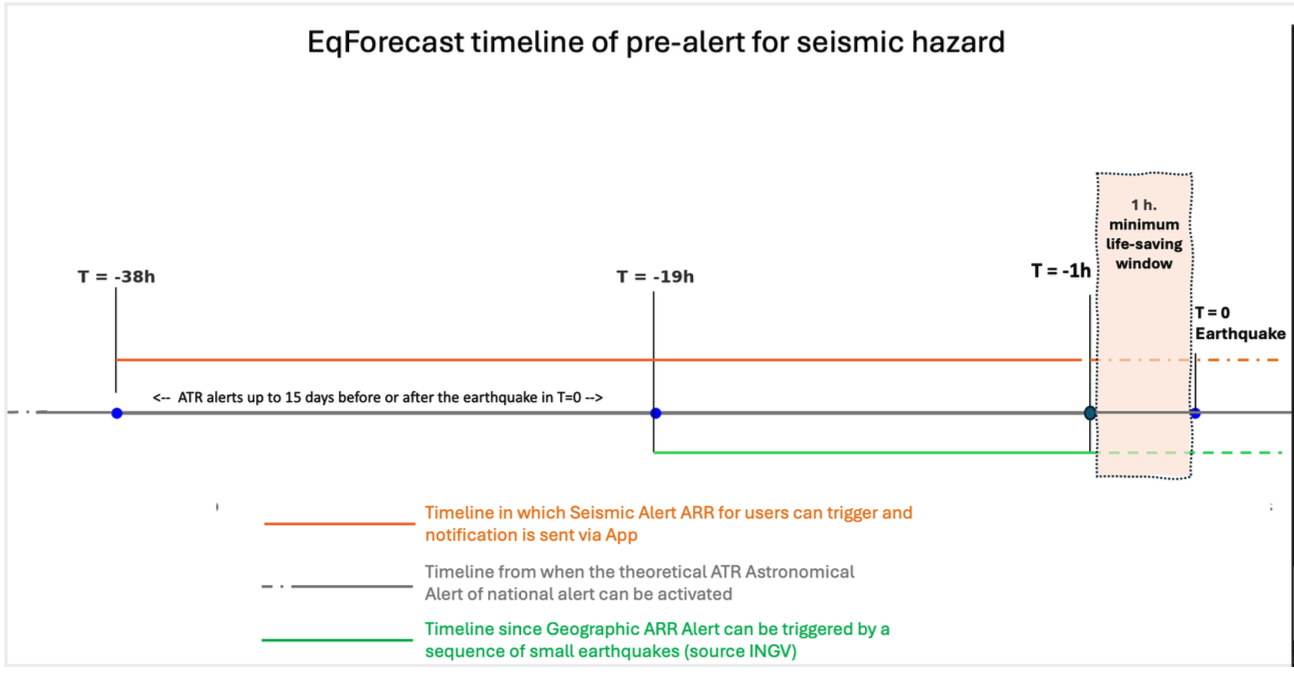
La Timeline EqForecast non nasce già “puntuale”. Parte da una condizione teorica più ampia e, con l’ingresso della microsismicità reale, si restringe progressivamente. Lo schema qui sotto aiuta a capire, in modo semplice ma corretto, come l’ARR – Allerta del Rischio Reale astronomico possa passare da una prima attenzione nazionale a una finestra finale più selettiva.The EqForecast Timeline does not start as a point prediction. It begins from a broader theoretical condition and, as real microseismicity enters the picture, narrows progressively. The diagram below helps explain, in a simple but accurate way, how the ARR – Astronomical Real-Risk Alert may evolve from initial national attention to a more selective final window.

EqForecast – Timeline of Real Risk Alert (ARR)
Schema operativo EqForecast: la linea grigia rappresenta il contesto ATR; l’ARR può attivarsi intorno a T=-38h; da circa T=-19h entra il restringimento geografico basato sulla risposta microsismica; la fascia evidenziata fra T=-1h e T=0 rappresenta la minimum life-saving window di 1 ora.EqForecast operational scheme: the grey line represents the ATR context; ARR may activate around T=-38h; from about T=-19h geographic narrowing based on microseismic response begins; the highlighted band between T=-1h and T=0 represents the 1-hour minimum life-saving window.
T = -38h

Avvio dell’ARRARR starts

La finestra entra in una prima fase di attenzione su scala nazionale. In questa fase il sistema registra segnali compatibili con un aumento della suscettibilità, ma il territorio interessato è ancora ampio.The window enters an initial national-scale attention phase. At this stage the system detects signals compatible with increased susceptibility, but the potentially affected territory is still broad.

T = -19h

Localizzazione progressivaProgressive localization

L’algoritmo geografico, insieme alla microsismicità osservata, consente di passare da una lettura nazionale a una lettura più selettiva. In altre parole, il WHERE comincia a restringere il campo.The geographic algorithm, together with observed microseismicity, allows the model to move from a national reading to a more selective one. In other words, WHERE starts narrowing the field.

T ≈ -1h

Life-saving windowLife-saving window

È il punto da mettere maggiormente in evidenza: il protocollo operativo mira a mantenere una minimum life-saving window di almeno 1 ora tra l’ultima allerta localizzata utile e l’evento atteso, nei casi in cui la procedura ARR e la localizzazione geografica convergono. Non è una garanzia valida per ogni terremoto, ma l’obiettivo operativo della catena di alert.This is the key point: the operational protocol aims to preserve a minimum life-saving window of at least 1 hour between the last useful localized alert and the expected event, in cases where ARR and geographic localization converge. It is not a guarantee for every earthquake, but the operational goal of the alert chain.

T = 0

EventoEvent

Se il terremoto si verifica, l’evento conclude la sequenza. Naturalmente si tratta di uno schema esemplificativo: non tutti i casi reali seguono la stessa identica cronologia, ma il principio generale è quello di un restringimento progressivo del rischio.If the earthquake occurs, the event concludes the sequence. Naturally this is an illustrative scheme: not every real case follows the exact same chronology, but the general principle is one of progressive narrowing of risk.

In breve: ATR = Allerta Teorica del Rischio astronomico; ARR = Allerta del Rischio Reale astronomico. L’ATR apre il contesto; l’ARR lo verifica e lo restringe con il comportamento reale della crosta.In short: ATR = Theoretical Astronomical Risk Alert; ARR = Astronomical Real-Risk Alert. ATR opens the context; ARR verifies and narrows it using the crust’s real behaviour.
1H
IL PUNTO CHIAVE DELLA CATENA DI ALLERTATHE KEY POINT OF THE ALERT CHAIN

Minimum life-saving window

Almeno un’ora come obiettivo minimo operativo tra la notifica localizzata finale e l’evento atteso. È la fase in cui il valore informativo del sistema è massimo, perché tempo e territorio sono già stati ristretti. La finestra non sostituisce i piani ufficiali di emergenza e non implica che ogni sisma sia prevedibile.At least one hour as the minimum operational target between the final localized notification and the expected event. This is the phase in which the system’s informational value is greatest because both time and territory have already been narrowed. The window does not replace official emergency plans and does not imply that every earthquake is predictable.

EqForecast + Early Warning

Perché EqForecast lavorerebbe bene insieme ai sistemi EEW basati sulle onde P.Why EqForecast can work well together with P-wave-based EEW systems.

EqForecast e i sistemi di Earthquake Early Warning (EEW) agiscono su tempi diversi e, proprio per questo, possono essere complementari in un’ottica multidisciplinare.EqForecast and Earthquake Early Warning (EEW) systems operate on different timescales and, precisely for this reason, can be complementary within a multidisciplinary perspective.

Prima dell’eventoBefore the eventEqForecast offre finestre temporali, aree di suscettibilità e classe di magnitudo compatibile con ore o giorni di anticipo. Serve per preparazione, organizzazione e pianificazione.EqForecast provides time windows, susceptibility areas and a compatible magnitude class hours or days in advance. It helps with preparedness, organization and planning.
Durante l’eventoDuring the eventL’EEW entra in funzione a sisma già iniziato: riconosce rapidamente le onde P e può guadagnare secondi preziosi prima dell’arrivo delle onde più distruttive.EEW becomes active once the earthquake has already started: it rapidly recognizes P waves and can gain precious seconds before more destructive waves arrive.
InsiemeTogetherUna filiera che unisca EqForecast, EEW, geologia, ingegneria sismica, protezione civile e sensoristica può aumentare la resilienza del sistema e il valore operativo dell’informazione.A chain that combines EqForecast, EEW, geology, seismic engineering, civil protection and sensor networks can increase system resilience and the operational value of information.
Una catena, non una competizione: EqForecast prova ad anticipare il contesto di rischio su scala di ore/giorni; i sistemi EEW a onde P intervengono quando la rottura è già iniziata e cercano di guadagnare secondi prima delle onde più dannose. In prospettiva, il quadro più robusto è multidisciplinare: previsione probabilistica + microsismicità + deformazioni del suolo + misure elettromagnetiche + accelerometri/onde P.One chain, not a competition: EqForecast attempts to anticipate the risk context on an hours/days timescale; P-wave EEW systems act once rupture has already begun and try to gain seconds before the most damaging waves arrive. In perspective, the strongest framework is multidisciplinary: probabilistic forecasting + microseismicity + ground deformation + electromagnetic measurements + accelerometers/P waves.
Agenda 2030 · SDGs

Il grado di coerenza di EqForecast con gli Obiettivi di Sviluppo Sostenibile.How EqForecast aligns with the Sustainable Development Goals.

L’Agenda 2030 delle Nazioni Unite, sottoscritta da 193 Paesi, definisce 17 obiettivi di sviluppo sostenibile. EqForecast si colloca soprattutto nella prevenzione del rischio, nella resilienza territoriale, nell’innovazione e nella collaborazione fra istituzioni, ricerca e cittadini.The United Nations 2030 Agenda, endorsed by 193 countries, defines 17 Sustainable Development Goals. EqForecast mainly aligns with risk prevention, territorial resilience, innovation and collaboration among institutions, researchers and citizens.

3
♥

SDG 3 · Salute e benessereGood health and well-being

Ridurre lo stress da rischio sismico, migliorare l’informazione e favorire comportamenti preventivi significa contribuire alla tutela della vita e del benessere delle persone.Reducing stress related to seismic risk, improving information and encouraging preventive behaviour contributes to the protection of life and well-being.

9
⚙

SDG 9 · Industria, innovazione e infrastruttureIndustry, innovation and infrastructure

EqForecast è un progetto tecnologico di R&S: app, backend, algoritmi, possibili integrazioni IoT e trasferimento tecnologico lo rendono un esempio concreto di innovazione applicata.EqForecast is a technology-based R&D project: apps, back-end, algorithms, possible IoT integrations and technology transfer make it a concrete example of applied innovation.

11
🏙

SDG 11 · Città e comunità sostenibiliSustainable cities and communities

È il collegamento più forte: comunità più informate e strumenti di allerta più maturi possono aiutare la resilienza urbana, la gestione del rischio e la sicurezza degli insediamenti umani.This is the strongest link: more informed communities and more mature warning tools can support urban resilience, risk management and the safety of human settlements.

13
🌍

SDG 13 · Azione per il clima / resilienza ai rischi naturaliClimate action / resilience to natural hazards

Pur non essendo un progetto climatico in senso stretto, EqForecast rafforza la cultura dell’adattamento e della resilienza verso grandi rischi naturali, tema centrale dell’Agenda 2030.Although not a climate project in the strict sense, EqForecast strengthens a culture of adaptation and resilience toward major natural hazards, a central theme of the 2030 Agenda.

17
🤝

SDG 17 · Partnership per gli obiettiviPartnerships for the goals

EqForecast si presta alla collaborazione con enti scientifici, istituzioni, protezione civile, scuole, ospedali, comunità locali e sistemi strumentali complementari.EqForecast lends itself to collaboration with scientific bodies, institutions, civil protection, schools, hospitals, local communities and complementary instrumental systems.

Altri collegamenti utili: SDG 4 (istruzione di qualità), SDG 10 (riduzione delle disuguaglianze territoriali rispetto al rischio) e SDG 15 (vita sulla Terra). Il progetto SAP – Servizio di Allerta Pre-Sismica si inserisce in questa visione di sviluppo sociale sostenibile.Other useful links: SDG 4 (quality education), SDG 10 (reduced inequalities in risk exposure) and SDG 15 (life on land). The SAP – Pre-Seismic Alert Service fits within this broader vision of sustainable social development.

Approfondisci sulle fonti.Go deeper into the sources.

Consulta i lavori pubblicati, i libri e le guide divulgative che descrivono l’evoluzione del modello.Explore published papers, books and public guides describing the evolution of the model.

Biblioteca EqForecast →EqForecast Library →